
By Bookum Team, May 29, 2026
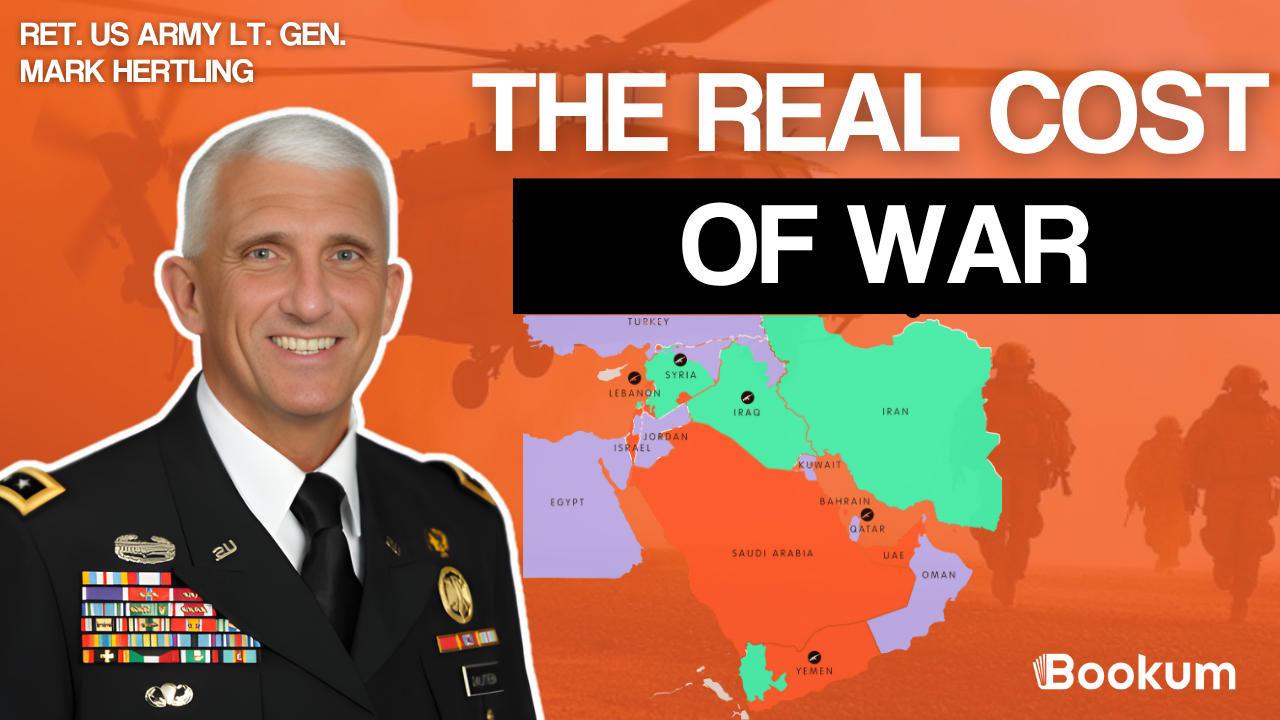
There are books about war.
And then there are books about what war reveals about being human.
Our conversation with General Mark Hertling falls into that second category.
We sat down with the retired Lieutenant General, former Commanding General of United States Army Europe, to discuss his book If I Don’t Return. What began as a wartime journal written during Operation Desert Shield (90s) and Desert Storm became something much larger: a reflection on leadership, faith, courage, family, and the lessons we leave behind.
The journal started as a letter to his two young sons.
At the time, Hertling believed there was a real possibility he would not come home.
His unit had been told to expect devastating casualties. He had a wife, two children, and a future that suddenly felt uncertain.
So he began writing.
Not about strategy or military operations.
About life.
About faith.
About friendship.
About how to choose a spouse.
About character.
About the kind of man he hoped his sons would become.
Three decades later, those journal entries became the foundation for a remarkable book that feels just as relevant to entrepreneurs, parents, teachers, and leaders as it does to soldiers.
It was a true pleasure having him on our Bookum Author Talks Podcast.
Listen to our full conversation with General Mark Hertling:
https://youtu.be/JDSTwxE4vb4?si=FgUXOY-7vUjiB6By
Apple Podcast, Spotify Podcast
Below are the biggest lessons from our conversation, edited for clarity and flow.
The Book Was Never Supposed To Be A Book
Kyle (Host): Can you set the stage for this moment and how the journal began?
General Mark Hertling:
“When I got to Iraq, what I started doing was writing a daily journal about things that I thought these two young boys would want to know as men.”
“Thoughts on faith and friendship and caring and picking out a wife.”
“When I came home, I threw the book into a footlocker and it stayed there for the next 30 years.”
The journal was not written for publication. It was written in case a father never returned home.
Leadership Is Built On Character
One of the strongest themes throughout the conversation was leadership. Leadership as responsibility and duty.
General Mark Hertling:
“It’s really about leadership and character and how do you address crisis.”
“It’s not just the successes. It’s a lot of the failures too.”
“How do you overcome fear? How do you get courage in tough situations?”
Many leadership books focus on victories.
Hertling focuses on mistakes and the scars. For the published book General Hertling when back to footlocker and add new leadership lessons he learned 30 years after the events from Desert Storm.
You Cannot Lead Others Until You Understand Yourself
After nearly four decades in uniform, Hertling now teaches leadership to MBA students.
One lesson continues to surface.
Self-awareness comes first.
General Mark Hertling:
“If you do not know who you are, you cannot present yourself to others.”
“Are you a truthful person? Do you have integrity? Do you care for other people?”
“Do you understand your values? Do you know what your values are?”
Leadership starts with understanding your own principles before trying to influence anyone else.
Leaders Do Not Have The Right To Have A Bad Day
One of the most memorable moments in our conversation centered on emotions.
General Mark Hertling:
“Leaders do not have the right to have a bad day.”
“As soon as you show your emotions that are negative, people are going to take on those negative emotions.”
“Organizations take on the personality of the leader.”
That does not mean leaders cannot struggle. Because they often do. It means they must understand that their attitude becomes contagious. They set the tone for the entire squadron, team, or business.
The culture of a team often mirrors the behavior of the person leading it.
Fear Is Not The Enemy
Fear appears throughout If I Don’t Return.
Not because Hertling lacked courage.
Because courage requires fear.
Kyle: How did you personally deal with fear during the Gulf War?
General Mark Hertling:
“My fear centered on my safety.”
“Will I lose my life? Will I never see my kids and my wife again?”
“You overcome fear by understanding that the opposite is courage and you have to show some type of courage.”
One of the most important takeaways from the conversation is that bravery is not the absence of fear.
It is movement despite fear.
The First Reports Are Always Wrong
We also discussed uncertainty and what military leaders call “the fog of war.”
The lesson extends far beyond combat.
General Mark Hertling:
“The first reports are always wrong.”
“You cannot get all the information.”
“You have to be prepared to deal with the unknowns and make adjustments.”
Whether you are leading a company, a family, or a team, uncertainty is unavoidable.
The goal is not perfect information.
The goal is adaptability.
Great Leaders Never Stop Learning
One of my favorite parts of the conversation had nothing to do with the military.
Hertling described arriving in New York as an 18-year-old heading to West Point and unexpectedly receiving tickets to a Broadway production of Porgy and Bess (his first ever play along side his then girlfriend now wife).
The experience changed him.
General Mark Hertling:
“Art and culture and going outside your comfort zone to experience something you’ve never experienced before really contributes to you being a good person.”
“It helps you understand people better.”
For Hertling, leadership is not only about tactical expertise but also about understanding humanity. Being culturally literate.
Reading.
Travel.
History.
Art.
Culture.
The broader your perspective becomes, the better your decisions become. The great leader you will be.
Some Stories Take Decades To Tell Honestly
One of the most powerful moments in the book involves General Hertling having to rewrite a lie (or omit) he had in his journal he wrote to this kids during Desert Storm.
During the war, he killed an enemy soldier in a close-range encounter.
When he first wrote about it for his sons, he left out that detail.
Years later, he decided to tell the full truth.
General Mark Hertling:
“That’s something that’s weighed on me this whole time.”
“When I wrote the reflection, I told the truth.”
“It was somewhat cathartic.”
The lesson is bigger than war.
Sometimes the stories we avoid are the ones we most need to confront.
Writing Became A Form Of Reflection
General Mark Hertling:
“There were some days where I was writing and going crazy.”
“And there were some days where I was sitting back from the computer crying my eyes out.”
“All of it was cathartic.”
The best books often emerge from a desire to understand life rather than explain it.
This feels like one of those books.
Final Thoughts
At first glance, If I Don’t Return appears to be a military memoir.
It is not.
It is a book about leadership.
About family.
About faith.
About courage.
About the values we hope survive us.
What stood out most during our conversation was not what General Hertling accomplished in uniform.
It was his willingness to reflect on mistakes, fears, doubts, and lessons learned along the way.
The book asks a simple but profound question:
If you had to leave behind a journal for the people you love most, what wisdom would you want them to carry forward?
That is what makes If I Don’t Return such a meaningful read.
Check out the full podcast with General Mark Hertling and make sure to download the Bookum app to join us for live book discussions, author conversations, and community reading experiences at Bookum.