
By Bookum Team, May 30, 2026
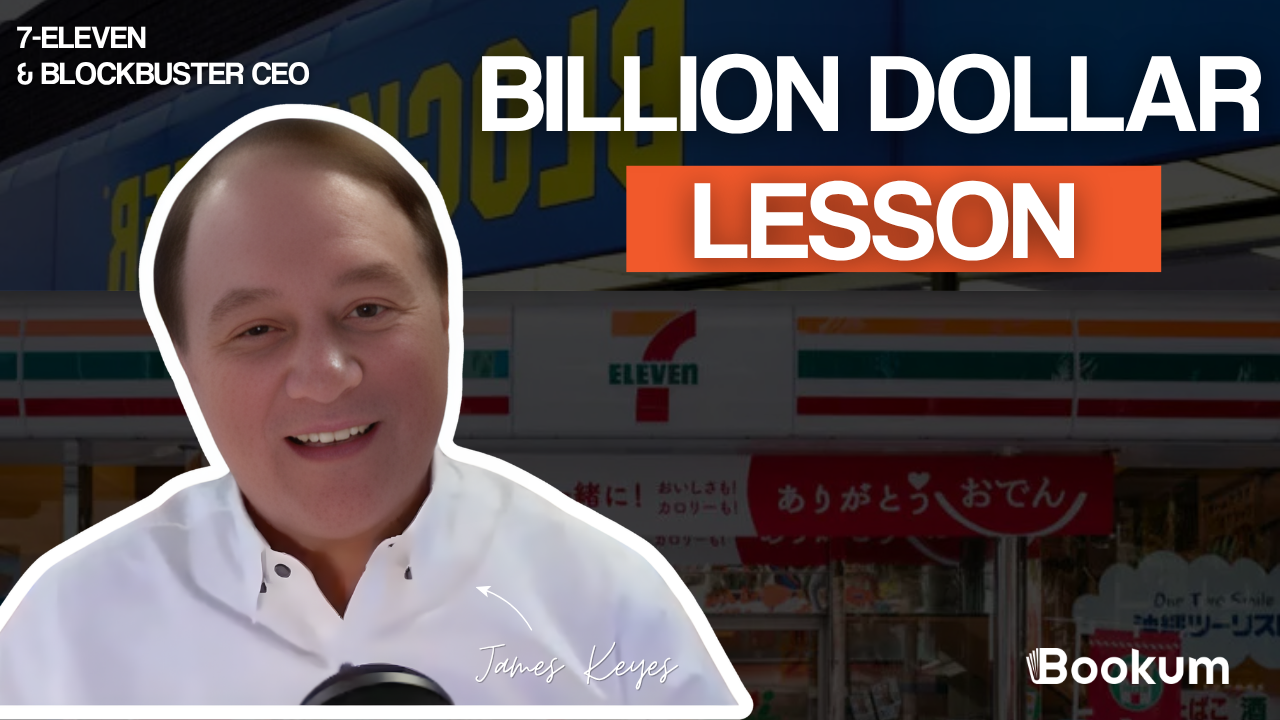
When most people hear the names 7-Eleven and Blockbuster, they think about convenience stores, Slurpees, movie nights, late fees .
These brands our synonymous with 90s nostalgia (especially Blockbuster).
Recently, I sat down with former 7-Eleven and Blockbuster CEO James Keyes to discuss his book Education Is Freedom. What surprised me was that our conversation covered some many topics outside of just Keyes’ business career.
It was about learning. Cultural literacy. Curiosity.
It was about the idea that the people who thrive are not always the smartest people in the room. Often, they are simply the ones who never stop learning and pursuing education.
It was a true pleasure having him on our Bookum Author Talks Podcast.
Listen to our full conversation with James Keyes:
Below are the biggest lessons from our conversation, edited for clarity and flow.
A Quote That Sat on His Desk for Decades
One of the first stories James shared was about a quote he was inspired by while working at McDonald’s as a teenager.
The quote was originally from President Calvin Coolidge and was later popularized by Ray Kroc (Or Michael Keaton depending on if you have seen the movie “The Founder”):
“Nothing in this world can take the place of persistence. Talent won’t. Nothing’s more common than unsuccessful men with talent. Genius won’t. Unrewarded genius is practically a cliché. Education won’t. The world is full of educated fools. Persistence and determination alone are all-powerful.”
The message resonated so deeply with him that he took the poster off the wall, mounted it on a board in shop class, and kept it on his desk.
For decades. Still to this day it hangs in his office.
Years later, he opened a book sent to him by Warren Buffett and found the exact same quote inside.
Success is rarely about talent alone.
Persistence wins.
The Best Leadership Book He Ever Read
I asked James what leadership books influenced him most.
I expected to hear names like Stephen Covey, Peter Drucker, or John Maxwell.
Instead, he gave an answer I did not see coming.
“The Boy Scout Handbook.”
His reasoning was simple.
Decades after first reading it, he could still recite the Scout Law from memory:
Trustworthy. Loyal. Helpful. Friendly. Courteous. Kind. Obedient. Cheerful. Thrifty. Brave. Clean. Reverent.
Those principles stayed with him long after the badges and uniforms disappeared.
His point was that leadership begins with character.
In a world obsessed with credentials, resumes, and titles, character remains one of the few true differentiators. The one you can’t fake.
As James put it, every person is like a product on a shelf.
The packaging matters.
But what is inside matters far more.
Why Travel Makes You a Better Leader
One of my favorite sections of the conversation centered around cultural literacy.
James told a story about studying abroad and realizing, for the first time, what it felt like to be the outsider.
That experience changed how he approached leadership.
When he later ran global organizations for 7-Eleven, he learned not to walk into another country assuming everyone would think, communicate, or negotiate the same way Americans do.
Instead, he learned to observe first.
Listen first.
Adapt second.
At a recent event at West Point, he watched a conductor demonstrate this principle through music.
Individual instruments played their parts separately.
Then the conductor brought the entire band together.
The result was harmony.
James used it as a metaphor for leadership.
Different people bring different strengths.
The goal is not uniformity.
The goal is learning how to create something greater together than any individual could create alone.
The Skills AI Cannot Replace
The conversation eventually turned to artificial intelligence.
Like many business leaders, James is optimistic about what AI can do, yet he is equally focused on what AI cannot do.
He calls them “meta skills.”
Things like:
- Curiosity
- Creativity
- Critical thinking
- Cultural literacy
- Adaptability (we got have at least one that doesn’t start with a C)
- Confidence
- Communication
These skills are becoming more valuable, not less valuable.
Technology can automate tasks.
It cannot automate wisdom and humanity itself.
James warned against overspecialization, especially for young people entering the workforce.
His own career advanced because he refused to stay in one lane.
Instead of becoming known as just a finance executive or just an operations executive, he moved across departments and functions.
By the time he became CEO, he had sat in nearly every important chair in the company.
That breadth became his competitive advantage.
It reminded me of Charlie Munger’s famous idea of developing a latticework of mental models across multiple disciplines. being multidisciplinary and taking the best ideas from all the different domains.
The future belongs to people who can connect dots across fields.
Change Equals Opportunity
One of the biggest lessons from the interview came from a simple acronym:
C.E.O.
For James, CEO does not just mean Chief Executive Officer.
It means:
Change Equals Opportunity.
That mindset shaped his entire career.
When I asked why he stayed at 7-Eleven for twenty years, I expected him to talk about success.
Instead, he talked about problems.
Corporate politics.
Bankruptcy.
Organizational turmoil.
Difficult bosses.
Adversity.
His argument was that while everyone else had their heads down trying to survive the chaos, he saw opportunity.
The challenges created openings.
The change created opportunities.
That mindset eventually propelled him into leadership.
The lesson applies far beyond business.
Most people spend their energy resisting change.
The people who grow learn how to work with it.
Education Is Still the Ultimate Investment
Toward the end of the conversation, we discussed the growing skepticism around higher education.
James understands the concerns.
Student debt is real.
Costs are significant.
But he argues that many people make the mistake of viewing education as an expense rather than an investment.
When evaluating a business, investors look at future cash flows.
They ask what the asset will produce over decades.
Education should be viewed the same way.
The return is not measured over the next year.
It is measured over a lifetime.
More importantly, education creates options.
It creates flexibility.
It creates freedom.
That is ultimately the core message of his book.
Not that education guarantees success or even a job.
But that education expands what is possible as humans.
Final Thoughts
At first glance, James Keyes has lived several lives.
He has been a CEO.
A pilot.
A musician.
A painter.
A traveler.
An entrepreneur.
An author.
What connects all of them is a willingness to keep learning.
Near the end of our conversation, he shared a simple idea:
Once you get over fear, you can do almost anything.
That might be the most important lesson from our discussion.
Education is not simply about earning degrees.
It is about developing the confidence to keep growing long after school ends.
Because freedom is not just having options.
Freedom is having the knowledge, curiosity, and courage to pursue them.
Check out the full podcast with James Keyes, get a copy of his book “Education is Freedom” and make sure to download the Bookum app to join us for live book discussions, author conversations, and community reading experiences at Bookum.’